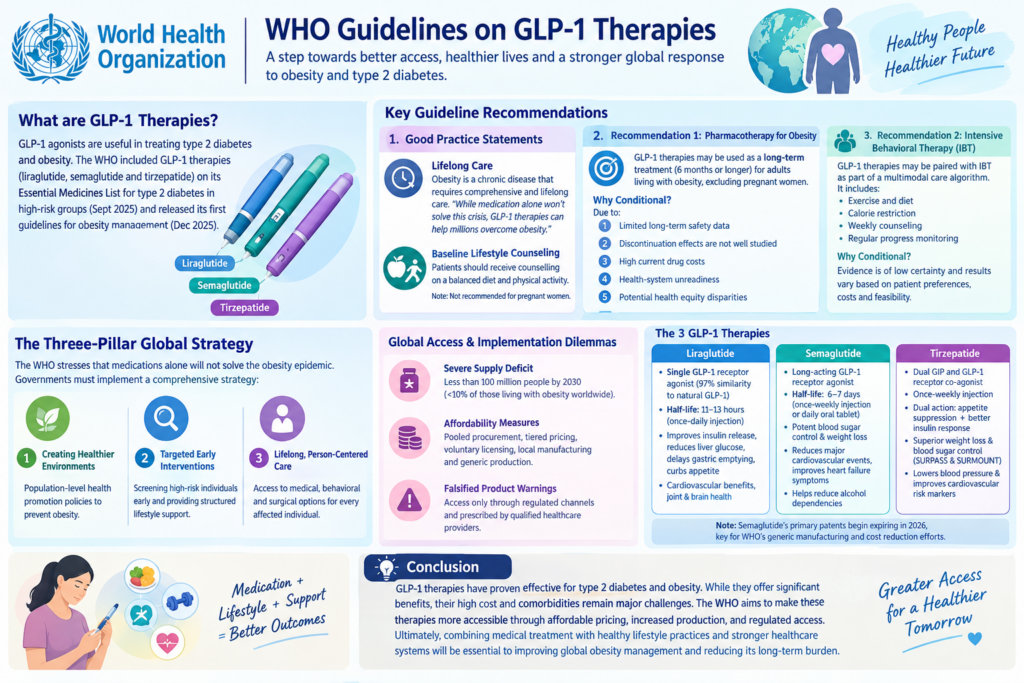
GLP-1 agonists are useful in treating type 2 diabetes and obesity. While GLP-1 medicines are safe to use, it is important to follow certain guidelines to avail its full benefits. On December 2025 WHO released its first guidelines addressing the use of GLP-1 therapies (specifically liraglutide, semaglutide and tirzepatide) for managing obesity as a chronic, relapsing disease. WHO included GKP-1 therapies on its Essential Medicines List for managing Type -2 diabetes in high-risk groups in September 2025. The guidelines were introduced to help a major health crisis; obesity. WHO issues conditional recommendations for using these therapies to support people living with obesity in overcoming this serious health challenge. WHO’s new guidance recognizes that obesity is a chronic disease that can be treated with comprehensive and lifelong care.
Key Guideline Recommendations
- Good Practice Statements
Lifelong Care: WHO’s new guidance recognizes that obesity is a chronic disease that can be treated with comprehensive and lifelong care. “While medication alone won’t solve this global health crisis, GLP-1 therapies can help millions overcome obesity and reduce its associated harms.”
Baseline Lifestyle Counseling: Those who have been prescribed GLP -1 medications are advised to avail counselling to maintain lifelong balanced diet and physical activities. Note: These medicines are not suggested to Pregnant Women.
- Recommendation 1: Pharmacotherapy for Obesity
Recommendation: GLP-1 therapies may be used as a long-term treatment (defined as continuous administration for 6 months or longer) for adults living with obesity, excluding pregnant women
Reason for Conditionality: While clinical trails are proving efficacy for weight loss and metabolic outcomes, the recommendation remains conditional due to
- Limited long-term safety which means there is less available data on how the medicines work on patients for long term use. and
- Discontinuation data which means there is less available data on what are the effects on discontinuation of medicine,
- High current drug costs, since the medicines are expensive not everyone can afford the medications.
- Health-system unreadiness since it is a developing environment for GLP-1 agonists the whole system will require time to be fully ready for it, and
- Potential health Equity disparities which mean there is potential unequal reach to all types of population.
- Recommendation 2: Intensive Behavioral Therapy (IBT)
Recommendation: Prescriptions for GLP-1 therapies may be paired with
Intensive behavioral therapy (IBT)—such as structured goal-setting as part of a multimodal care algorithm. It includes:
- Exercise and diet,
- Calorie restriction,
- Weekly counseling, and
- Regular progress monitoring etc
Reason for Conditionality: Evidence supporting added efficacy when combining IBT with GLP-1 medications is of low certainty, alongside variations in patient preferences, implementation costs, and context-specific feasibility. This is because the results vary since patients prefer different lifestyle, some patient may afford or not afford the IBT and medicines both. And thus the results are feasible according to implementations of suggested activities and obedience to clinical recommendations.
The Three-Pillar Global Strategy
The WHO stresses that medications alone will not solve the global obesity epidemic. Instead, governments must implement a comprehensive three-pillar strategy:
- Creating Healthier Environments: The govt should establish population level health promotion policies to prevent obesity.
- Targeted Early Interventions: Individuals falling under high risk category should be screened early for prevention by providing structured lifestyle support.
- Lifelong, Person-Centered Care: Every affected individual should have access to undiscriminated medical behavioral and surgical options
Global Access & Implementation Dilemmas
- Severe Supply Deficit: Existing production forecasts project that GLP-1 therapies will reach fewer than 100 million people by 2030—representing less than 10% of those living with obesity worldwide
- Affordability Measures: Due to high cost of GLP-1 agonists WHO is under prevention of global health gaps, The WHO calls for pooled procurement, tiered pricing, voluntary licensing, local manufacturing, and generic production of GLP-1 agonists
- Falsified Product Warnings: Due to overwhelming global demand, the WHO warns against the rise of counterfeit and substandard GLP-1 products, emphasizing that medications must be accessed strictly through regulated distribution channels and prescribed by qualified healthcare providers
The WHO global guideline specifically highlights liraglutide, semaglutide, and tirzepatide as the primary class of GLP-1 therapies evaluated for long-term obesity management
- Liraglutide: Liraglutide is a single GLP-1 receptor agonist that shares 97% sequence homology with natural human GLP-1
Administration & Half-Life: It has an elimination half-life (the amount of time it takes for the concentration of the medication in your bloodstream to decrease by half) of 11–13 hours and requires a once-daily subcutaneous injection
Mechanism & Clinical Highlights:
- Liraglutide enhances glucose-dependent insulin release and reduces excess liver glucose production by suppressing glucagon.
- It delays gastric emptying and acts on brain satiety centers to curb appetite.
- It demonstrates cardiovascular benefits, reduces joint cartilage degradation and inflammation in osteoarthritis models, and has shown modest positive effects on motor function in early-stage Parkinson’s disease trials
- Semaglutide
Semaglutide is a long-acting single GLP-1 receptor agonist
Administration & Half-Life: It has an extended half-life of 6 to 7 days, allowing for once-weekly subcutaneous injections. It is also available as a once-daily oral tablet
Mechanism & Clinical Highlights:
- Delivers potent blood sugar control and substantial body weight reduction.
- Significantly reduces major cardiovascular events and improves symptoms in heart failure.
- It helps cutting down on alcohol dependencies
- Tirzepatide
Drug Class & Structure: Tirzepatide is a dual GIP and GLP-1 receptor co-agonist. Rather than targeting only the GLP-1 receptor, it activates both the glucose-dependent insulinotropic polypeptide (GIP) receptor and the GLP-1 receptor simultaneously
Administration & Half-Life: Administered as a once-weekly subcutaneous injection
Mechanism & Clinical Highlights:
- Dual Action: GLP-1 receptor activation suppresses appetite and reduces glucagon, while GIP receptor activation further stimulates postprandial insulin secretion and enhances overall glucose utilization.
- Superior Efficacy: In head-to-head Phase 3 clinical trials (SURPASS and SURMOUNT programs), tirzepatide demonstrated superior weight loss and blood sugar reduction compared to semaglutide and standard insulin regimens.
- Cardiometabolic Benefits: Significantly reduces 24-hour blood pressure and improves cardiovascular risk biomarkers in adults with obesity or type 2 diabetes
Note: Global Patent Context: Semaglutide’s primary patents begin expiring in 2026, making it a key focus for WHO efforts to introduce generic manufacturing and lower global costs.
CONCLUSION:
GLP-1 agonists are proven effective on treating type 2 diabetes and obesity. By improving blood glucose control, regulating appetite, and supporting weight loss, these medicines can help reduce the health risks related to obesity and related metabolic outcomes. However, their long-term use requires appropriate medical supervision, lifestyle modifications, and regular monitoring. Through measures such as affordable pricing, increased production, and regulated access to safe and effective medicines, the WHO aims to make GLP-1 therapies more accessible to people who need them.